Choosing The Best Material For Your Garage Door Replacement
At some point, every garage door reaches the end of its lifespan — even with diligent maintenance. When that time comes, choosing the right replacement isn’t just about picking a style or color you like. The material you choose determines how long your new door will last, how much maintenance it will need, how well it insulates your garage, and how it holds up against the unique demands of Arizona’s climate.
This guide breaks down every major garage door material, including the pros, cons, and how each one performs in the East Valley’s extreme heat — so you can make an informed decision before you invest.
One thing worth understanding upfront: almost all residential garage doors today are built on a steel or aluminum frame. What we refer to as the door’s “material” often describes the overlay — the facing material applied to that steel frame at the factory. Wood overlays, vinyl overlays, and composite overlays can all be applied to a steel base, giving you design options without changing the underlying structural construction. This distinction matters because it affects how you maintain the door and how it responds to Arizona’s climate.
📖 Related: 3 Unbeatable Benefits of Energy Efficient Garage Doors
Why Material Choice Matters More in Arizona
Most garage door buying guides are written for a national audience — but what works in a mild Midwest climate or a rainy Pacific Northwest region is not necessarily the right choice for the East Valley. Arizona’s summer temperatures regularly exceed 110°F, UV radiation is among the most intense in the country, and monsoon season brings sudden humidity, dust, and moisture that can stress certain materials far more than a typical year elsewhere.
The right material for your Arizona home should be able to handle extreme heat without warping or fading, resist UV degradation, provide meaningful insulation to help control garage temperatures, and require a reasonable amount of maintenance given those conditions. Keep this lens in mind as you read through each option below.
📖 Related: How a Damaged Garage Door Could Put You at Risk
Steel Garage Doors
Steel is the most popular garage door material in North America — and for good reason. It offers the best combination of strength, durability, design flexibility, and value for the money.
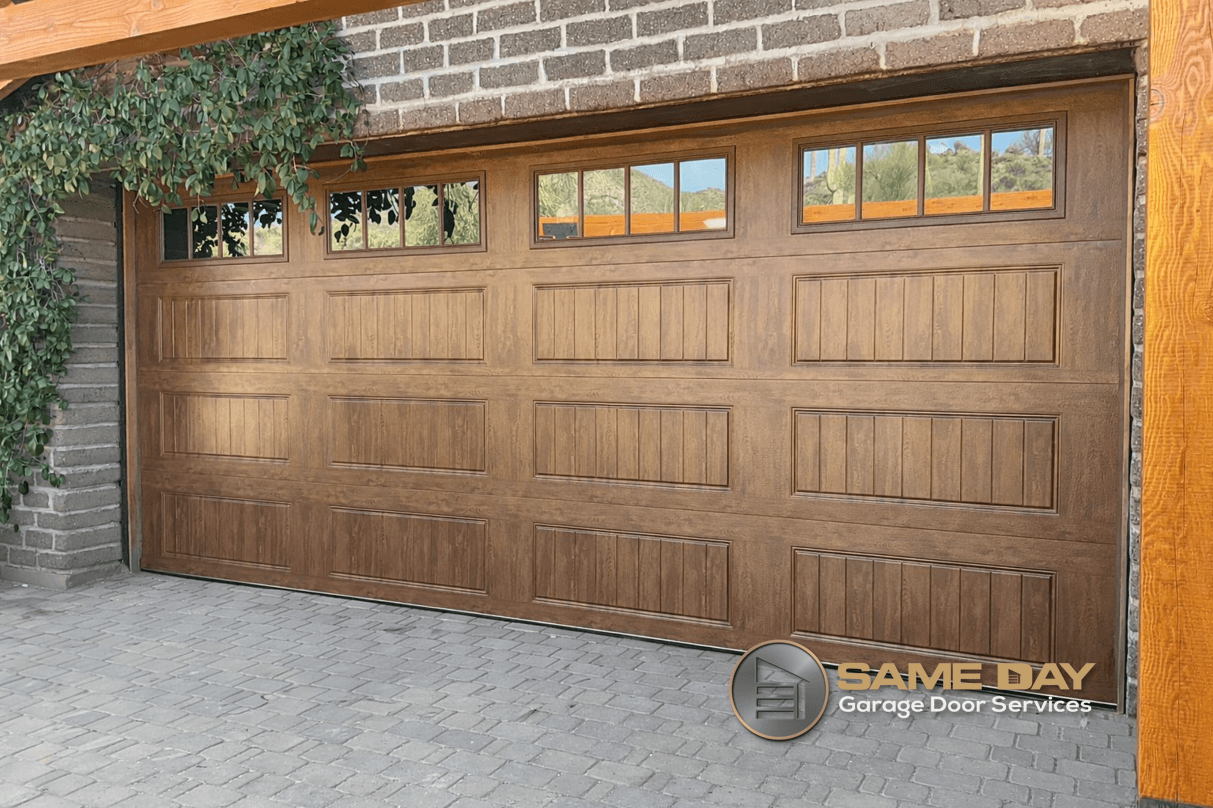
Steel doors are available in a wide range of styles, from traditional raised panels to realistic wood-grain finishes that are nearly indistinguishable from real wood at curb distance. They can be painted any color and hold paint well over time.
For Arizona homeowners, insulated steel is the top recommendation. An uninsulated steel door conducts heat rapidly — in a garage exposed to 110°F temperatures, an uninsulated door allows interior temperatures to climb to dangerous levels, damaging stored vehicles, belongings, and anything else inside. Look for steel doors with a polyurethane foam core, which provides a higher R-value per inch than polystyrene. For an attached garage, aim for a minimum R-value of R-16 to R-18 or higher.
The main downside of steel is susceptibility to rust over time — particularly along the bottom edge. Washing the door a couple of times a year removes the dirt and grime that accelerates rust formation.
📖 Related: Maintenance Tips For Your Garage Door
Wood Garage Doors
Wood is the classic choice — and it remains the most visually striking option available. Real wood doors can be stained, painted, carved, or fitted with custom molding to create a truly unique look that no other material can fully replicate.
The tradeoff is maintenance. In Arizona’s climate specifically, wood requires significantly more upkeep than in milder regions. The combination of intense UV radiation, extreme heat, and low humidity dries wood quickly — leading to cracking, warping, and paint failure if the door isn’t properly sealed and refinished on a regular schedule. Plan for annual refinishing or repainting and close inspection for any signs of joint separation or cracking. For a full breakdown of what regular garage door maintenance involves, Angi’s garage door maintenance guide is a helpful resource.
Wood also provides limited insulation on its own. If energy efficiency is a priority, you’ll need to invest in an insulated wood door or add insulation separately.
Our honest take for Arizona homeowners: if you love the look of wood but want to avoid the maintenance demands, a steel door with a realistic wood-grain finish gives you the aesthetic of wood with the durability and low upkeep of steel — and most visitors won’t be able to tell the difference.
Aluminum Garage Doors
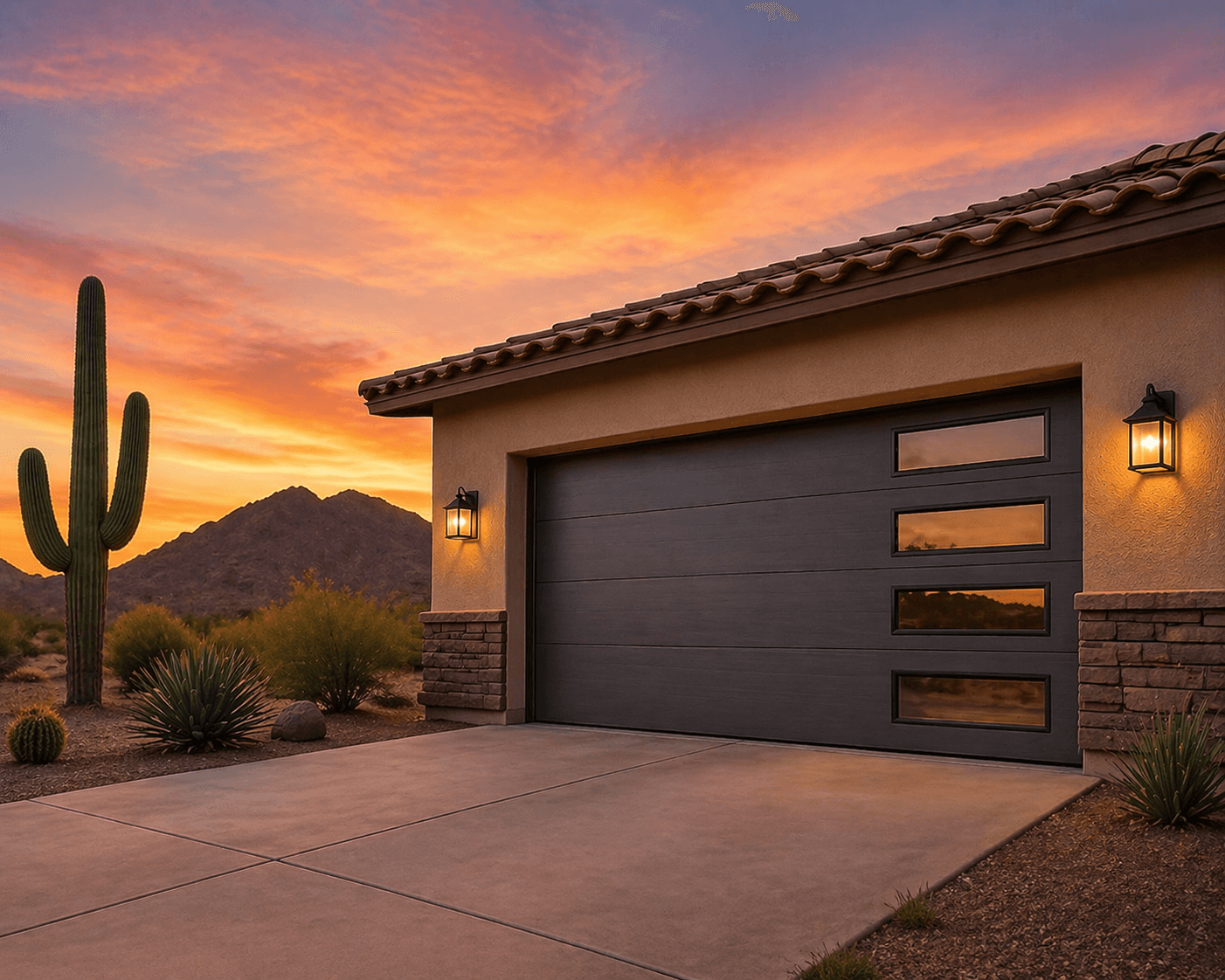
Aluminum is a lightweight, rust-resistant material that has become especially popular for modern and contemporary home designs. Aluminum frames paired with glass panels create a sleek, full-view door that’s visually distinctive and allows natural light into the garage.
Aluminum doesn’t rust or corrode, holds paint well, and requires minimal maintenance. However, it is more susceptible to denting than steel, and its low R-value is a meaningful concern in Arizona. Aluminum conducts heat efficiently — without proper insulated glass and thermal breaks in the frame, an aluminum door provides little resistance against the desert heat. If you choose aluminum, look specifically for doors with insulated glass units and thermally broken framing to get any meaningful energy performance.
Vinyl Garage Doors
Vinyl is one of the most low-maintenance options available. It won’t rust, corrode, dent, or scratch easily, and it can be painted in a wide range of colors including realistic wood tones.
However, vinyl has significant limitations for Arizona homeowners. Most vinyl doors consist of vinyl sheeting over a lightweight aluminum grid frame — they don’t offer the strength or durability of a well-constructed steel door. More importantly, vinyl can fade significantly with prolonged UV exposure, especially in darker colors. In Arizona’s intensity of sun, this is a real concern that will affect the door’s appearance well before the end of its mechanical lifespan.
A critical Arizona-specific warning on vinyl overlays: The exterior surface of a garage door in the East Valley can reach upwards of 180°F in direct summer sun. Vinyl overlay doors should never be painted a dark color or black in our climate. At those temperatures, dark-colored vinyl can begin to deform — causing a condition called delamination, where the vinyl overlay starts to separate from the steel door beneath it. Once delamination begins, the panel must be replaced. If you choose vinyl, stick to lighter, reflective colors and confirm with your installer that the product is rated for extreme heat environments.
Vinyl may work well for a detached, lower-use garage where aesthetics and insulation are less critical — but for a primary attached garage in the East Valley, steel or aluminum are stronger choices.
📖 Related: How to Pick the Right Springs for Your Garage Door
Quick Comparison: Best Material for Arizona Homeowners
According to Clopay — one of the country’s leading garage door manufacturers — steel and aluminum doors with light, reflective finishes perform best in hot climates by helping keep the garage cooler. Here’s a quick summary of the four materials we carry and install:
Material | Durability | Maintenance | Arizona Heat | Highest Insulation Available | Best For |
|---|---|---|---|---|---|
Steel | ⭐⭐⭐⭐⭐ | Low | ✅ Excellent (insulated) | Up to R-18+ | Most homeowners — best overall value |
Wood | ⭐⭐⭐ | High | ⚠️ Needs sealing | Up to R-10 (with added insulation) | Custom aesthetics, higher budgets |
Aluminum | ⭐⭐⭐ | Low | ⚠️ Needs insulated glass | Up to R-8 (insulated glass required) | Modern/contemporary homes |
Vinyl | ⭐⭐⭐ | Very Low | ⚠️ UV fading risk | Up to R-6 | Detached/lower-use garages |
What About R-Value and Insulation?
Insulation is one of the most important — and most overlooked — factors in a garage door purchase, especially in Arizona. R-value measures a door’s resistance to heat transfer: the higher the R-value, the better it keeps extreme temperatures out of your garage.
For an attached garage in Arizona, aim for R-16 or higher. A well-insulated door reduces the heat load on your home’s HVAC system, keeps the garage usable during summer months, and helps protect stored belongings and vehicles from extreme temperatures. According to the U.S. Department of Energy, insulated garage doors can contribute meaningfully to a home’s overall energy efficiency — particularly in extreme climates like Arizona’s.
📖 Related: How Often Should I Get My Garage Door Opener Serviced?
Get Expert Garage Door Installation in Gilbert, Mesa & the East Valley
Choosing the right material is the first step — professional installation ensures your investment performs the way it should for years to come. Same Day Garage Door Services can help you select the perfect door for your home’s architecture, budget, and the specific demands of Arizona’s climate, and then install it with the care and precision it deserves.
We carry a full range of garage door styles and materials and serve Gilbert, Mesa, Tempe, Chandler, Queen Creek, Ahwatukee, and the entire East Valley. Contact us today for a free estimate on a new garage door, or schedule your installation online.
📖 Related: Common Garage Door Problems That Need to Be Addressed

Trevor L.