When Should My Garage Door Springs Be Replaced?
Your garage door is composed of many components working together — tracks, rollers, cables, the opener, and the springs. Of all these parts, the springs do the heaviest work. They carry the full weight of the door every time it opens and closes, and when they start to fail, the effects ripple through the entire system quickly.
Knowing when to replace your garage door springs — and recognizing the warning signs before a complete failure occurs — is one of the most important things a homeowner can understand about their garage door system.
📖 Related: Leading Causes and Solutions for Broken Garage Door Springs
Why Your Garage Door Springs Are So Important
Garage door springs counterbalance the full weight of the door, making it possible for the opener motor to lift and lower it smoothly with minimal effort. Without properly functioning springs, the door’s entire weight falls directly on the opener motor — which is not designed to carry that load. Running the opener against an unbalanced door accelerates motor wear dramatically and can cause the opener to fail prematurely.
When springs fail entirely, the consequences are more serious. A door without functioning springs can fall suddenly, creating a significant safety hazard for anyone or anything in the garage. According to the U.S. Consumer Product Safety Commission (CPSC), garage doors are responsible for approximately 30,000 injuries per year in the United States — spring failures are among the most dangerous contributors.
📖 Related: The Dangers of Replacing a Garage Door Spring by Yourself
Torsion Springs vs. Extension Springs
There are two types of springs used on residential garage doors, and their lifespan and failure characteristics differ slightly.
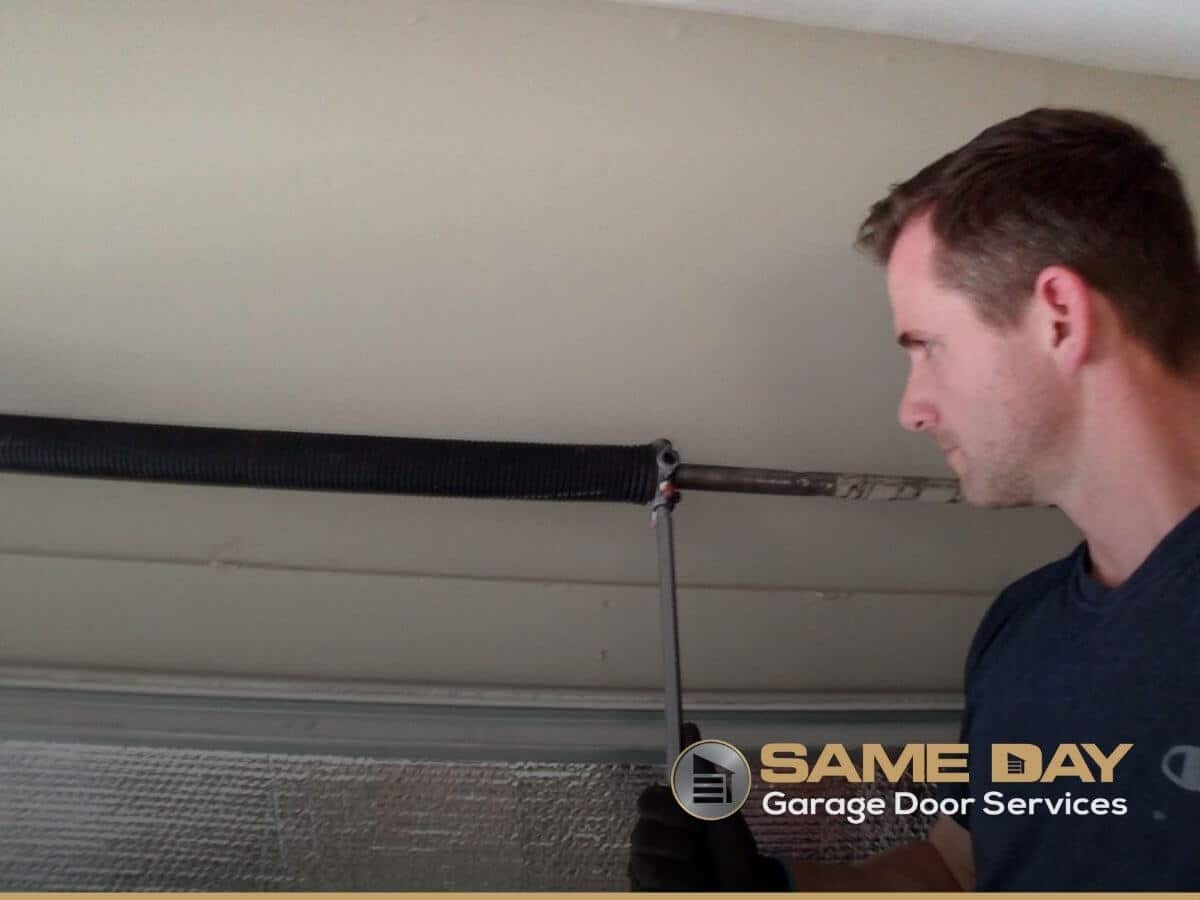
Torsion springs mount horizontally above the garage door opening on a metal shaft. They are the industry standard for most modern sectional doors. When a torsion spring breaks, it typically stays on the shaft — making it safer than the alternative, though still in urgent need of professional replacement.
Extension springs run alongside the horizontal tracks on each side of the door. They stretch and contract as the door opens and closes. Extension springs require safety containment cables running through them — if a spring snaps without a cable, it can fly loose at high speed. Both types should only ever be replaced by a licensed garage door technician.
How Long Do Garage Door Springs Last?
Spring lifespan is measured in cycles — one cycle equals one complete open-and-close operation. Standard residential springs are rated for approximately 10,000 cycles, which translates to roughly 7–10 years for most households depending on usage frequency.
For a family that opens and closes the garage door four times a day — morning and evening for two drivers — that 10,000-cycle mark arrives in less than seven years. Higher-use households may need replacement in as few as five years.
Arizona homeowners should also factor in climate. The East Valley’s extreme heat — regularly exceeding 110°F in summer — accelerates metal fatigue in springs, particularly in garages without insulated doors. Springs in Arizona’s desert climate may wear faster than the national average, making annual inspections especially important.
High-cycle springs are a worthwhile upgrade at replacement time. Rated for 20,000+ cycles, they cost somewhat more upfront but can double or triple the time between replacements — a strong long-term value for any household with frequent garage door use.
📖 Related: How to Pick the Right Springs for Your Garage Door
Signs Your Garage Door Springs May Need Replacing
Don’t wait for a complete spring failure — the warning signs typically appear well in advance. Watch for any of the following:
Screeching, squealing, or grinding sounds during operation — springs that are fatiguing or need lubrication often become noisy
Visible rust or corrosion on the spring coils — surface rust weakens the metal and accelerates failure
A stretched or gapped spring — a torsion spring that appears elongated or has visible gaps between coils is losing tension and needs replacement
The door moves unevenly — if one side rises faster than the other, the springs are losing balance
The door feels extremely heavy when lifted manually — a sign the springs are no longer properly counterbalancing the door’s weight
A loud bang from the garage — a sudden sharp noise is often the sound of a spring snapping. Stop using the door immediately and call a professional
The opener struggles or strains — if the motor is working harder than usual, failing springs may be putting excessive load on it
📖 Related: Common Garage Door Problems That Need to Be Addressed
What Happens If You Ignore a Failing Spring?
Many homeowners see the warning signs and put off calling for service. A spring that’s partially failed puts uneven load on the opposite spring, the cables, and the opener motor — all of which begin to wear at an accelerated rate. What would have been a single spring replacement can quickly become a full system repair involving cables, drums, and the opener motor.
In the worst case, complete spring failure causes the door to drop suddenly, potentially damaging a vehicle or injuring someone in the garage. The cost of ignoring a warning sign is almost always higher than the cost of acting on it promptly.
📖 Related: The Dangers of a Malfunctioning Garage Door
Always Have Springs Replaced by a Professional
Garage door spring replacement is not a DIY project. Springs operate under extreme mechanical tension — enough to lift a door weighing 150 to 400 pounds — and improper handling can result in serious injury. As DASMA — the industry’s leading trade association — emphasizes, spring replacement should always be handled by a trained door systems technician due to the extreme tension involved.
Professional technicians use calibrated winding bars, tension gauges, and safety clamps that aren’t available to the average homeowner. They also ensure the replacement springs are correctly matched to your door’s specific weight and dimensions, which is critical for proper balance and longevity.
Get Same-Day Spring Replacement in Gilbert, Mesa & the East Valley
If your garage door springs are showing any of the warning signs above, or if you simply can’t remember the last time they were inspected, don’t wait. Same Day Garage Door Services provides fast, professional spring inspection and replacement throughout Gilbert, Mesa, Tempe, Chandler, Queen Creek, Ahwatukee, and the entire East Valley. We offer free, no-obligation estimates on new garage doors, and all of our work is backed by a 100% satisfaction guarantee. For a current breakdown of what spring replacement typically costs in the Phoenix metro area, Angi’s local cost guide is a helpful reference.
Contact us today for a free estimate on a new garage door, or schedule your service online.
📖 Related: Garage Door Repair Scams and What to Watch Out For

Trevor L.